|

|

|
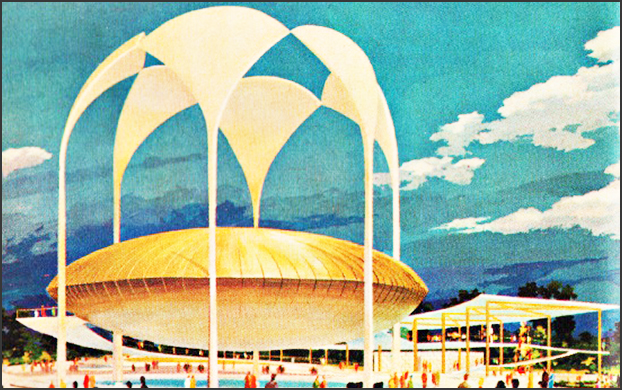
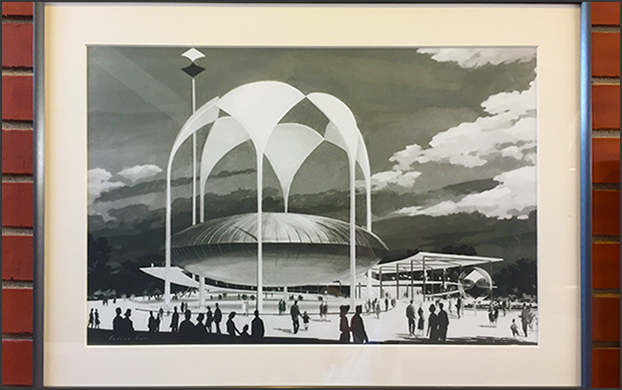
Artwork
of the Johnson's Wax pavilion as it appeared at the New York World's
Fair 1964/1965*

This
pavilion, a great gold disk which seems to float 24 feet above the
ground, is supported by its surrounding columns. It houses a
500-seat theater in which a documentary movie dramatizes the theme of
brotherhood. An exhibition at ground level offers a climbing
contraption for the entertainment of children, a home care information
center and a shoeshine center that provides free shines. On
the
ground floor is a display which shows the wide range of materials man
has used as floors, from marble to teakwood. Pavilion guides
are
foreign students.
Admission:
free.
"To Be Alive." This
sensitive 18-minute color movie, produced by Francis
Thompson,
whose documentaries have won many awards, uses three projectors, as
many screens, and stereophonic sound to show the daily lives of people
around the world. They grow up, fall in love, work, play and
grow
old, demonstrating that "men everywhere share at the deepest level the
same drives, dreams, foibles.
Child
Entertainment Center.
Grown-ups can watch while children climb through a 'fun
machine'
- a mazelike device full of mirrors that fracture images, squeeze-bulbs
that emit strange noises and cranks that operate robots.
Shoeshine
Center. Ten polishing machines operating
simultaneously can buff the shoes of 300 visitors an hour.**

The Golden Rondelle presented a
film which was void of any
advertising or product placement gimmicks. In fact, the
President
of Johnson's Wax deliberately told his team that he simply wanted
visitors to his exhibit at the Fair to have a wonderful time.
The
result was "To Be Alive!", a film which took viewers on a journey
through the shared emotion of joy. It was considered to be
one of
the highlights of the Fair.
In a connected area, younger
visitors could experience the joys of being alive in the "Child
Entertainment Center"... An elaborate, interactive playground.
It was an offering fitting for a pavilion which was meant to
help
remind people of the joys of simply being alive.
A small exhibit space showcased various Johnson's Wax products and
offered shoeshine services.

At
the conclusion of The Fair, the "Golden Rondelle"... the floating
disk-like theater of the pavilion, was carefully dismantled and shipped
to Johnson Wax's headquarters in Racine, Wisconsin. There,
the
team of architects at Frank Lloyd Wright's Taliesin were employed to
design a new structure and enhancements for the Golden Rondelle which
would be more akin to the rest of the brick buildings on the
campus. The result was an odd combination of Frank Lloyd
Wright's
classic architecture and the space-age design of the Johnson's Wax
World's Fair pavilion.
Where a reflecting pool once existed
underneath the Golden Rondelle, a nice shaded plaza now
stands.
Benches provide a place for people to rest before entering the building
for one of SC Johnson's presentations or their monthly showing of the
pavilion's original film, "To Be Alive!".
Inside the Golden
Rondelle, the theater looks pretty much exactly as it did during The
Fair. Red carpet and red upholstery are used
throughout.
The ceiling is painted a shiny gold. The projection room for
the
theater has experienced upgrades and a new print of "To Be Alive!" was
commissioned in recent years to ensure this timeless film is available
for future generations.
"To Be Alive!" went on to win an Academy Award for "Documentary Short
Subject" the year after The Fair closed in 1966.

The
Golden Rondelle just happened to be just off my route to a convention I
was attending in Milwaukee, Wisconsin, so I took the opportunity to
turn off of the highway and drive into the heart of Racine.
Aside
from experiencing the Disney attractions from the Fair in their current
homes at Disneyland and Walt Disney World, this would be my first time
seeing a World's Fair structure outside of Queens.
As
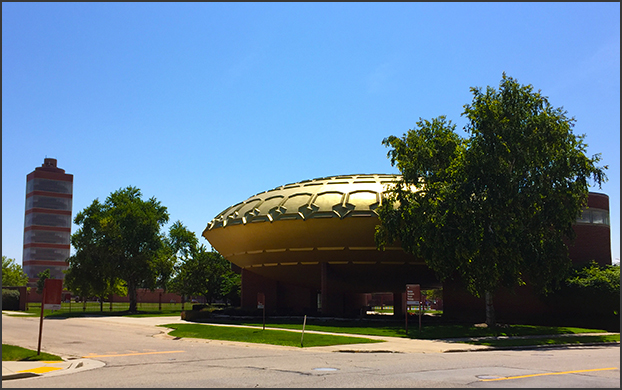
I pulled down the road, I caught a glimpse of the shiny Golden
Rondelle. It sits along the side of the road, just outside
the
perimeter fence of the SC Johnson headquarters.
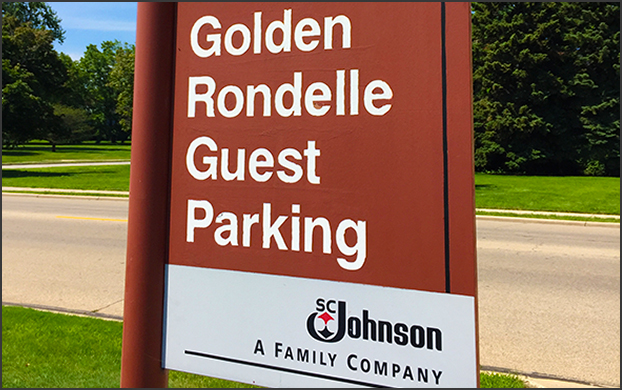
A stand-alone
driveway with a modest, tree-lined parking lot serves the Golden
Rondelle. I parked my car and began to walk around this
beautiful
and deceivingly small structure to take it all in and snap some
photographs of the building and its surroundings.
|
|
|
 |
|
Prior
to my visit, I had reached out to the team at the Golden Rondelle to
see if there might be a way to get in to snap some photos.
The
day of my visit was going to be the only opportunity I had to stop by,
and I was concerned because the building wasn't scheduled to be open to
the public while I was there.
Thanks to Michelle and Markist
from SC Johnson, I was able to get access for a few minutes to snap a
few photos and ask a few questions about this beautiful remnant of the
World's Fair. |
The
main building was designed by the architects at Taliesin, Frank Lloyd
Wrights school, when the pavilion was moved to Racine following the
Fair. They wanted to create a structure which looked like the
existing buildings on campus... which were designed by Frank Lloyd
Wright, himself.
The Golden Rondelle, with its space-age lines
and supports, just wound't fit in at its new home, so this building was
designed to "hug" the original theater building. |
|
 |
 |
|
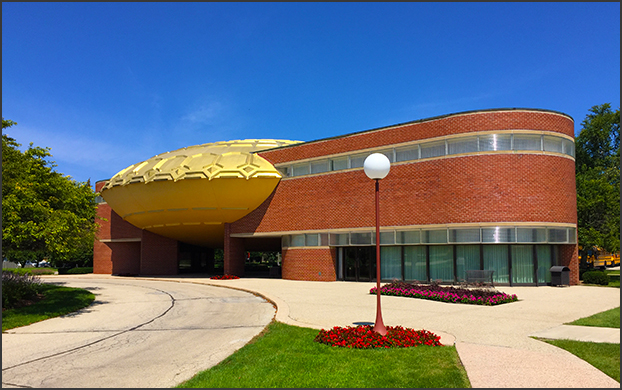
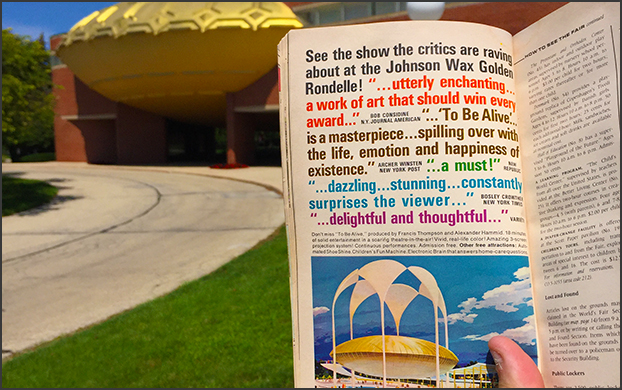
I pulled
out my Official Guide and read up on the pavilion and its offerings as
I waited to meet Michelle and Markist.
I
tried to imagine the flying saucer-shaped theater building with its
original supports. I tried to imagine the wrap-around ramp
full
of visitors. I tried to imagine the smiling visitors exiting
the
theater after having viewed "To Be Alive!".
A smile crossed my face and I, myself, was happy to be alive just being
in the presence of this slice of World's Fair history. |
With a
smile on my face, I continued to explore the Golden Rondelle.
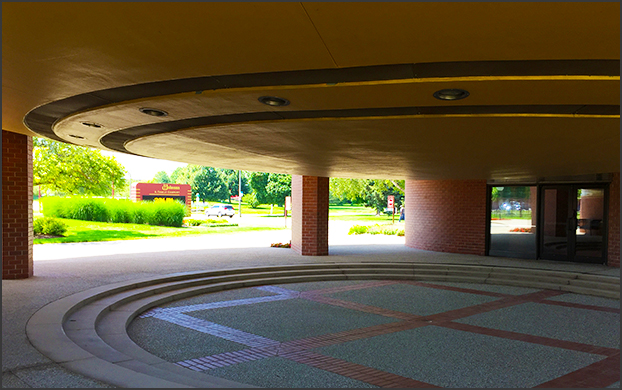
Underneath
the theater, where a reflecting pool with fountains existed during the
Fair, stands a courtyard area with benches. It's a nice,
shaded
area for people to wait for one of the theater's monthly showings of
"To Be Alive!". The wrap-around ramp wasn't part of the new design,
replaced by sets of glass doors on either side of the courtyard which
lead to a lobby and staircase inside the new building. |
|
|
 |
|
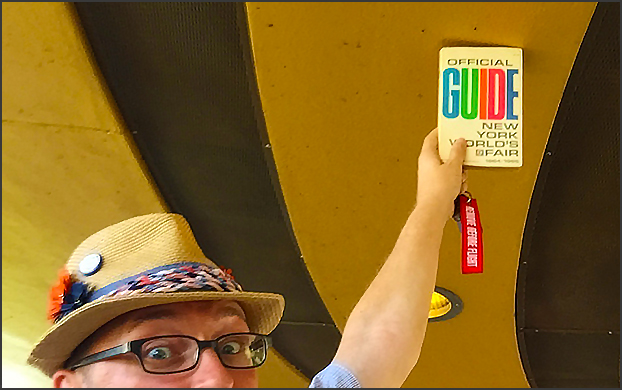
Having an
opportunity to touch the Golden Rondelle just by standing under it was
just something I couldn't resist.
Standing
on the top step of the courtard, I stretech upward to touch it, but
fell a little short...so I pulled out my Official Guide and it made up
the difference.
Here I was, connecting two old friends from a bygone event. |
Michelle
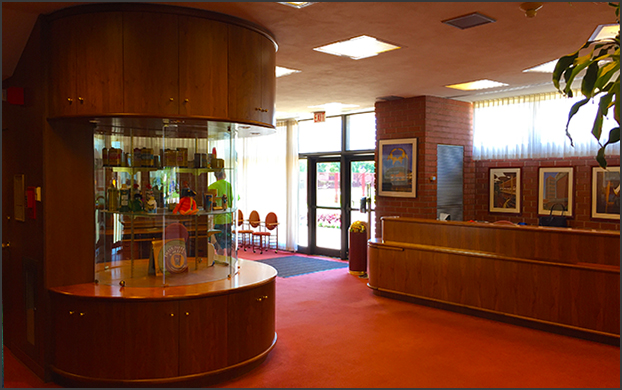
met me at the door and invited me into the lobby. There, you'll find a
display cabinet with a display of some of the various products
Johnson's Wax/SC Johnson has sold over the years. In a way,
it
was like a much reduced version of the exhibit listed in the guidebook
during the Fair!
Behind the reception desk were prints of
concept artwork and photos of the Golden Rondelle as it appearead at
the New York World's Fair. Just around the cabinet to the
left
were the stairs leading up to the Golden Rondelle theater. |
|
 |
 |
|
It
was so nice to see that SC Johnson has made sure that anyone who visits
the Golden Rondelle can catch a glimpse of its origins and perhaps ask
questions to learn more.
Beyond the reception desk are rows of
chairs, designed by the team at Taliesin, for visitors to relax in
while they wait to be escorted up to the theater. |
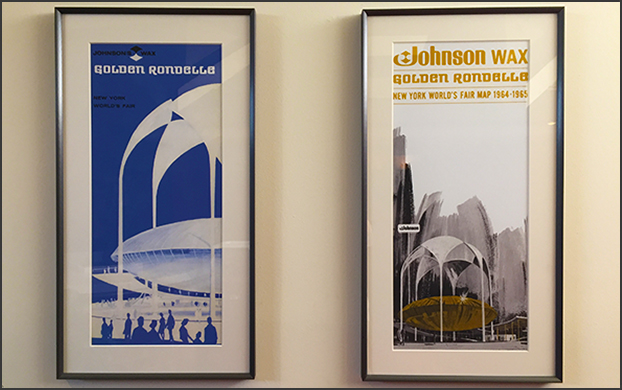
Following
Michelle and Markist up the stairs, I noticed these two enlargements of
map covers from the Fair. These maps would have been given to Johnson's
Wax VIPs visiting the Fair.
The maps would have contained
suggestions for exhibits to visit and additional information about
their own pavilion. The artwork was simple and effective. I
especially enjoyed the font they used for "Golden Rondelle". |
|
|
 |
|
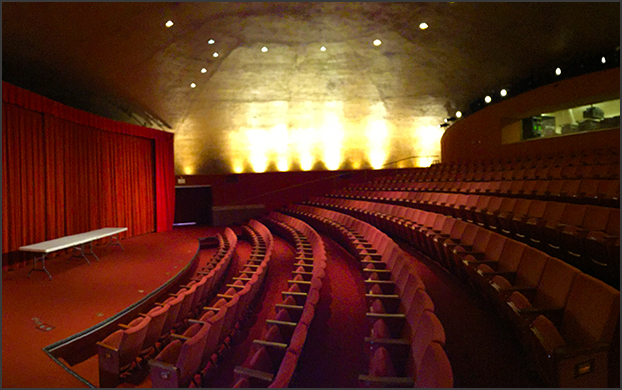
At
the top of the stairs, a wide pair of double doors open to reveal the
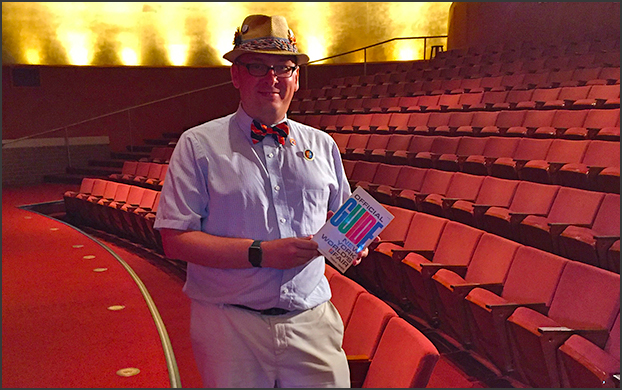
cavernous theater of the Golden Rondelle. The theater's dome,
painted in a shiny gold, shimmers as you enter thanks to perimeter
lighting around the edge of the theater.
The seats, stage,
carpet, and curtains are all in a deep red, similar to how it appeared
during the New York World's Fair. The projection booth has
been
upgraded and shows several films each month... including "To Be Alive!". |
Following
a brief chat with Markist about the theater and "To Be Alive!", I asked
him to snap a photo of me with my guidebook to finish my visit.
Even
though I wouldn't be able to view "To Be Alive!" during this visit, I
was happy to just be able to walk into this amazing building and take a
moment to enjoy this remant of the New York World's Fair 1964/1965. |
|
|
 |
|
If
you're ever in Racine, Wisconsin, you really should take the time to
stop and visit the Golden Rondelle. If your schedule permits,
you
should visit on one of the days they are showing "To Be Alive!" so you
may experience this World's Fair attraction for yourself.
If you do happen to stop by, be sure you tell Michelle and Markist that
I said hello! |
 This
remnant of the World's Fair is regularly maintained by the team at SC
Johnson's headquarters. The team which manages the building
is
well-informed of the Golden Rondelle's history and definitely
appreciates its contribution to the World's Fair community.
Tours
of the campus each week include the Golden Rondelle and also include a
brief history lesson about the importance of the theater.
Monthly
showings of "To Be Alive!" ensure that this pavilion maintains much of
its original World's Fair purpose. This
remnant of the World's Fair is regularly maintained by the team at SC
Johnson's headquarters. The team which manages the building
is
well-informed of the Golden Rondelle's history and definitely
appreciates its contribution to the World's Fair community.
Tours
of the campus each week include the Golden Rondelle and also include a
brief history lesson about the importance of the theater.
Monthly
showings of "To Be Alive!" ensure that this pavilion maintains much of
its original World's Fair purpose.
Visit the Golden Rondelle on
days when "To Be Alive!" is showing. Visitors may reserve a
seat
for a showing of by visiting their website.
It is highly recommended that you arrive early so you may take in the
beauty of the architecture before heading inside the theater.
Tours
of the entire SC Johnson campus, which was designed by famous architect
Frank Lloyd Wright are also available throughout the month. A
link to tour times is available on the page linked above.
Giving Thanks.
The
following individuals contributed towards making it possible for me to
visit and document this remnant of the 1964/1965 New York World's Fair.
I'd like to take a moment to personally thank them for
helping
make my dream of personally visiting the remaining pavilions of the
World's Fair come true.
Reesa Martin
Michelle and Markist from the SC Johnson Golden Rondelle
This page is hereby dedicated to them.
*Advertisement Image - Scanned from the personal collection of Jason
"Tiki"
Tackett.
**Official Guidebook Information - Official
Guide New York World's Fair 1964/1965 (c.1964 Time Inc.)
|
|
|
|