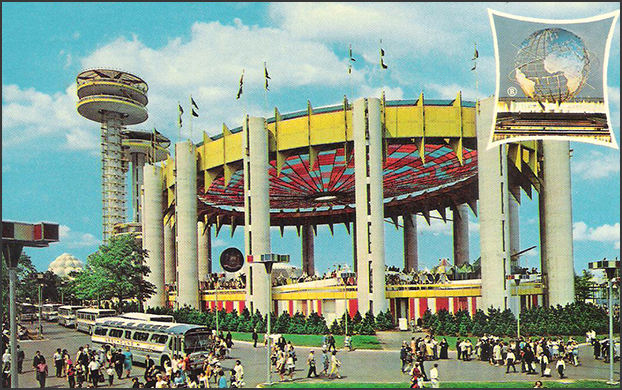
Postcard
of the New York State pavilion, published by Dexter Press*
Looming over the New York State pavilion are three observation towers,
one of which is the tallest structure at the Fair (226 feet).
Beneath the towers is the Tent of Tomorrow, the world's
biggest suspension roof (it is larger than a football field), supported
by sixteen 100-foot concrete columns. Translucent colored
panels in the roof flood the interior of the tent with colors.
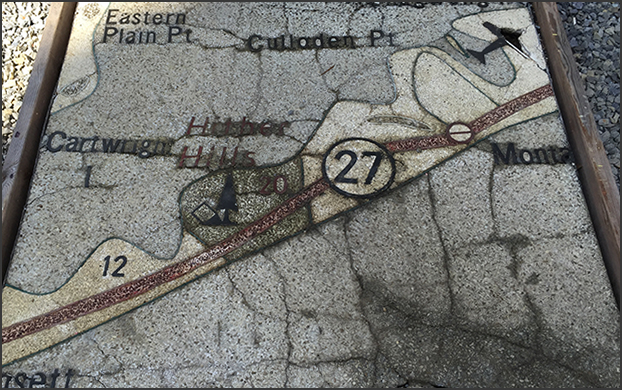
On the main floor, Texaco Oil Company has made a mammoth map
of the state in terrazzo. Around the map are a number of
attractions, including an exhibit by the New York State Power
Authority, a fine arts gallery, fashion shows and an automat.
On the mezzanine, visitors may have an opportunity to meet
state legislators. Next to the Tent of Tomorrow is the
Theaterama, a large, cylindrical movie theater decorated with
controversial "pop" art.
Admission: free to the pavilion; Observation Tower, adults 50 cents,
children 25 cents; Theaterama, 25 cents.
Highlights
High Spot of the Fair. Speedy
"Sky Streak" capsule elevators zip up the sides of two of the towers,
and on a clear day observers on the tallest can see New Jersey,
Connecticut, the Atlantic Ocean, and most of Long Island.
This tower is an observation platform; the middle tower sells
refreshments,; the third is a lounge for visiting dignitaries.
Fine
Arts. Two large
collections have been assembled from many sources. One shows
portraits of early New York colonists; the other offers examples of the
famous Hudson River school of painting of the 19th Century.
Plenty
of Power. The New York State Power Authority
shows its power network on a 144-square foot map. The utility
also exhibits a 26-foot replica of the St. Lawrence hydroelectric
plant, with spinning turbines seen through transparent panels.
Highway
Through New York. On the mezzanine, strollers
walk along a miniature highway lined with glimpses of the state's life
- a conservation area, a rose garden, exhibits from regional museums
and the state's smaller industries. Members of the state
legislature are on hand, and New Yorkers who feel there ought to be a
law about something can state their gripes in writing, to be delivered
to Albany. A machine answers questions about New York's
legistative process.
Pop
Art. The paintings decorating the Theaterama are
of such unlikely subjects as an automobile wreck, a comicstrip redhead
and black dinner jackets draped over a ladder.
State
Movie. Inside the theater, moving pictures are
projected onto a 360-degree screen, transporting the viewer to Niagra
Falls, Jones Beach and similar state scenes.** Architect Philip Johnson was
contracted by the State of New York to design the "host pavilion" for
the New York World's Fair 1964/1965. The result was a
futuristic set of observation towers with what resembled flying saucers
atop each, an enormous multifunction exhibit space, and a theater with
a projection format similar to that of Disney's CircleVision.
The Tent of Tomorrow, with its colorful translucent roof reminiscent of
Notre Dame's rose window floating overhead and cheerful color scheme,
was deemed "carnival with class" by Ada Louise Huxtable.
Amongst the various forms of architecture on display at the
Fair, the New York State pavilion stood above it all, beckoning Guests
arriving at the New York City Transit station to the far end of the
Fair for an amazing time.
Serving as the showcase of the Empire State, the New York State
pavilion was designed to live on beyond the two year event.
Built with true foundations and constructed to be a permanent
structure after the Fair ended, the pavilion was meant to become a
functional part of Queens... serving the local community as well as
promote tourism. At the
conclusion of The Fair, the New York State pavilion found a limited
opportunity to serve the community. It stood empty for years
following the end of the Fair... becoming a roller skating
rink for a brief period of time and serving as a concert venue.
During its time as a roller skating rink, careful care was taken to
protect the terrazzo map of New York by applying several protectant
layers. The rink (called the "Roller Round") was popular
amongst teens and adults while it operated. During its
operation, some of the colorful translucent panels of the suspension
roof reportedly came loose, blew off the building, and landed
on the
nearby freeway, prompting the closure of the roller skating rink...and
the building itself... for safety reasons. It would remain
closed to the general public
from that point on.
In recent years, a grass roots effort to help the pavilion find
adaptive
reuse has grown. The New York State
Pavilion Paint Project
currently spends volunteer hours and donated funds painting the
mezzanine structure to
look similar to how it did during the Fair. In 2014, the New
York State pavilion was designated a national treasure by the National
Trust for Historic Preservation, paving the way for additional
stabilization and restoration. In 2020, work began on the
first phase of restoration work on the observation towers and the
partial restoration of some of the pavilion's architectural lighting. I
have visited the New York State pavilion several times and will
continue to do so
whenever I have the opportunity. There is something about
this
hulking modern ruin which just sparks my imagination. With
recent
pushes to stabilize and restore the pavilion, it's even easier to see
the potential of completing the restoration and reopening it to the
public.
My
first visit to the pavilion was
in March of 2015, when I was given an unexpected opportunity to travel
to New Jersey and New York. The trip took place just before
Disney's Tomorrowland was released in
movie theaters. As a New York World's Fair fan, I was excited
by
the scenes in the previews, which showed that the Fair would play a
rather important part in the film's
storyline. Having never been to the actual site of the Fair
and
being so close, I wanted to take the opportunity to visit Flushing
Meadows Corona Park. Needless to say, I immediately fell in
love.
My first
visit to Flushing Meadows-Corona Park was, in essence, my personal
"reward" for the work I had done for my friend
John's New Jersey-based business. Fortunately, my friends Nicole
and Joe (whom I was staying with) lived in Manhattan and understood the
subway system. They made it possible for me to actually get to
the site of the World's Fair...and the New York State pavilion.
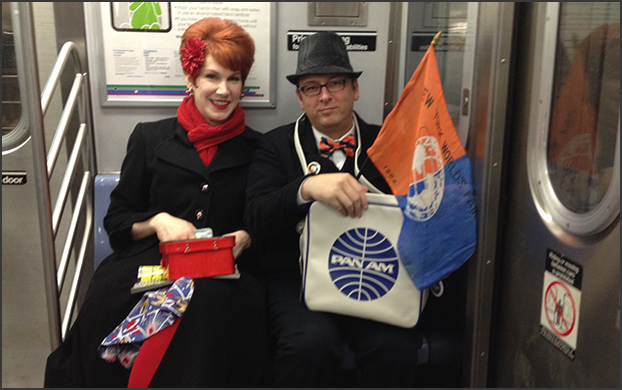
As
you can see in the photo, Nicole loves to dress up in
vintage-style attire (as do I). Her enthusiasm and our
dressing up would make for
some wonderful photos once we arrived at the Fair.
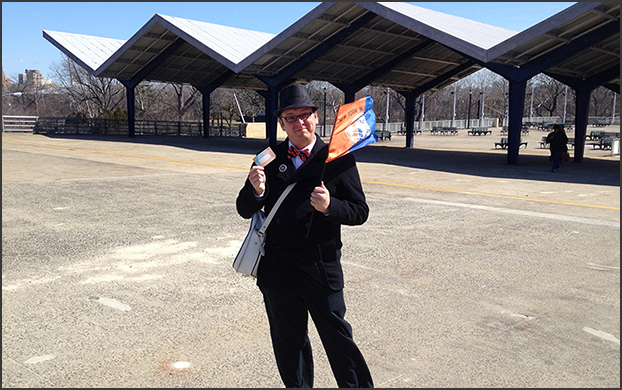
Arriving
at Willets Point station, I pulled out my authentic World's
Fair ticket and had her snap a photo of me at the entrance.
The
beautiful zig-zag rooflined structure is from the 1964/1965 Fair and
stands on the Passerelle, which was built for the 1939 Fair.
Between where I was standing and the roofline would have
stood a
row of white ticket booths. People would have been lined up to
purchase their admission to a world which promoted "Peace Through
Understanding".
Beyond the roof, a world of wonder awaited lucky visitors.
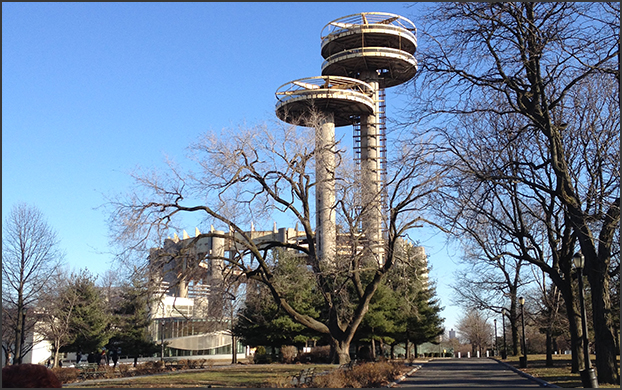
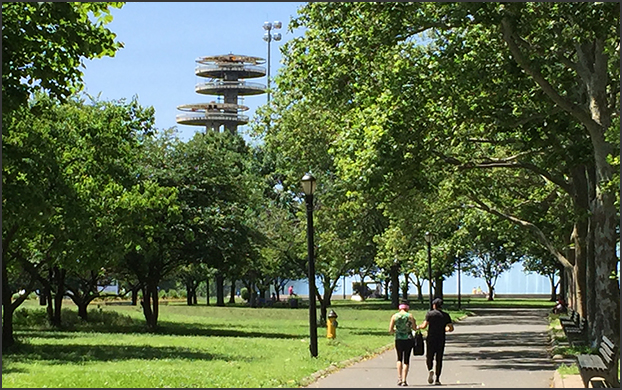
After
braving the wind and freezing cold temperatures on our walk, we could
see the New York State pavilion rising
proudly over the trees. After a brief pause at the Unisphere
(visit my travelogue on that attraction later), we
made our way down the Avenue of the States to the pavilion.
While this "grand lady of the park"
was showing her age, you could see the beauty of her design and easily
imagine how glorious she would have looked in her heyday as the "host
pavilion" of the 1964/1965 New York World's Fair.
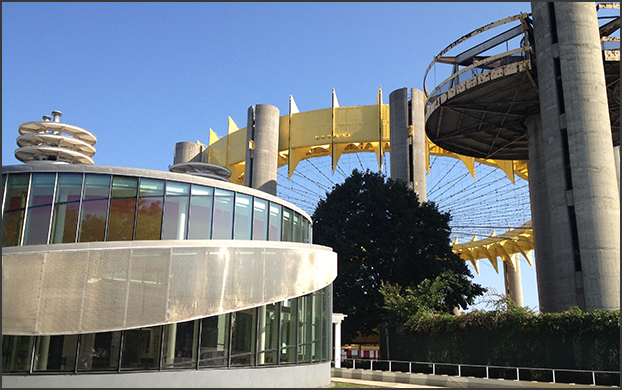
While
weathered and a little rusty, her tall towers, with their flying
saucer-like observation decks still maintain elements of
optimism and futurism.
Below, the Theaterama had been converted to the Queens
Theater, a
performance venue which successfully serves the community's needs.
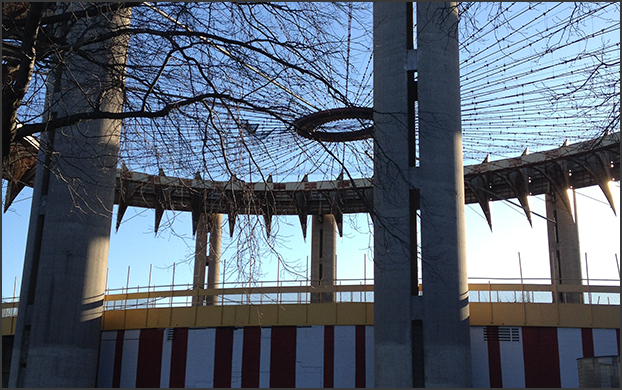
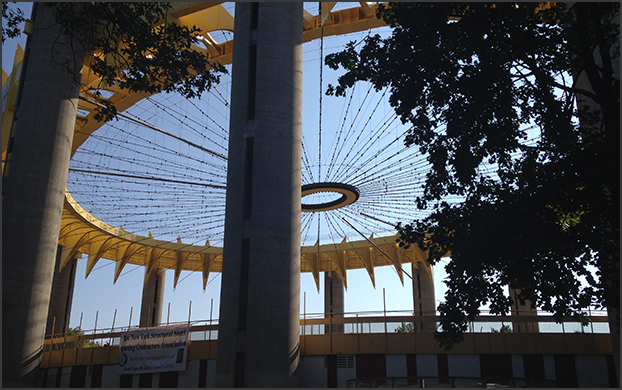
The
Tent of Tomorrow, located behind the towers and theater, was a shell of
its former grandeur, with its colorful roof gone and globeless lamp
posts askew
in places. Paint work on the mezzanine structure gave a
sample of
how cheerful this structure once was.
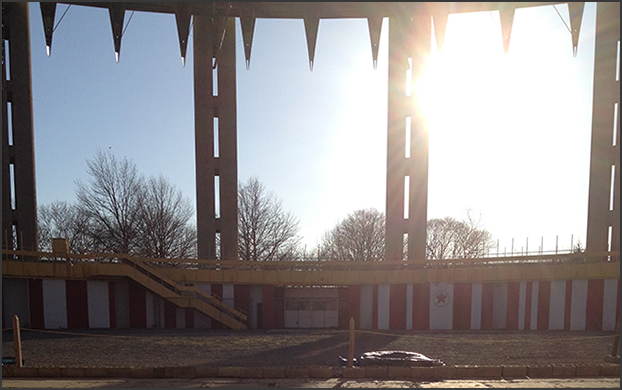
Peeking
through the locked gate, we could see inside the large exhibit area,
where what remains of the terrazzo map of the state of New York rests
under layers of material and gravel. The space was
huge, and the paintwork which was done on the outside to brighten up
the structure was matched on the inside.
The roof, the largest
suspension cable roof in the world at the time it was built, was a
faded shade of tan. Surface rust covered it like freckles.
My
next visit would take place in July of 2015. Again, I was in
New
Jersey/New York to assist my friend with his business. As
part of
the trip, I decided to once again visit Flushing Meadows-Corona Park to
see the restoration work which I had heard was being done on the
pavilion.
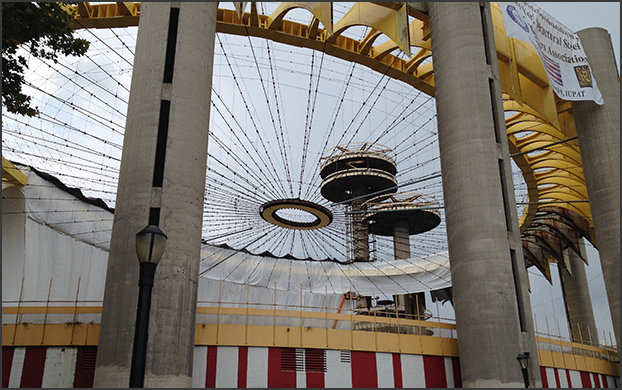
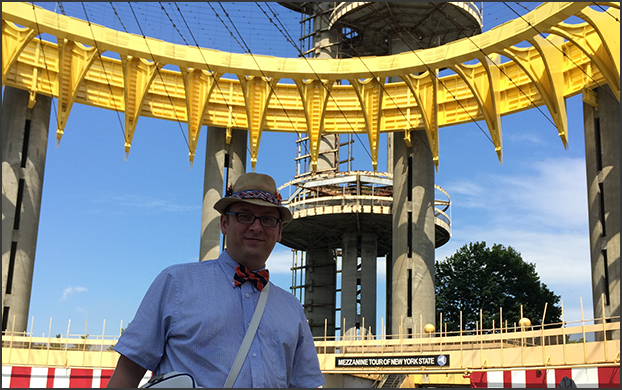
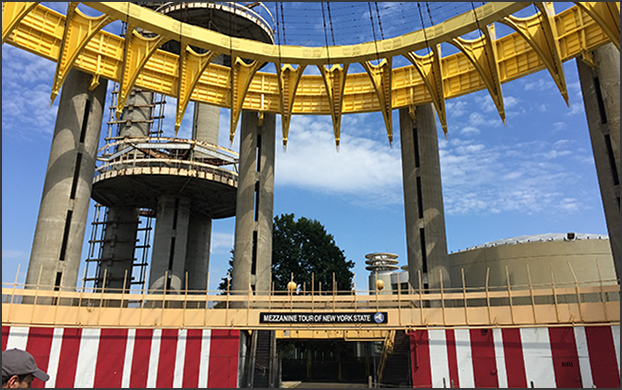
Upon my
arrival, I was able to see first-hand the progress being made to
stabilize, seal, and paint the Tent of Tomorrow's crown.
Bright and colorful in its original shade of "American Cheese
Yellow", the pavilion was finally starting to look like itself again!
The
following visit would last just four short hours as part of a layover
in my flight from Ohio to Florida in September of 2015. I
intentionally selected these flights so I would have a chance to visit
my happy place once again and see the finished paintwork on the crown.
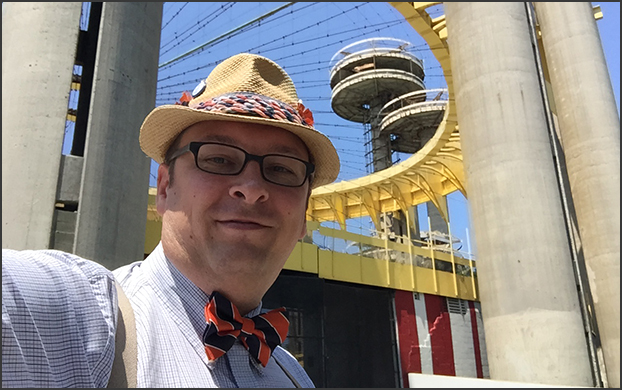
When
the Uber driver dropped me off just outside the Queens Museum, I could
already see the pavilion, shining bright in the sun. Enjoying
the
afternoon breeze, I took a walk around the pavilion to take in the
beauty of the restored crown.
It
really is amazing what a coat of paint will do to refresh something.
With the enormous crown of the Tent of Tomorrow finished, it
was
even easier to imagine the joy just looking at this pavilion during the
Fair would have brought.
With
both the crown and mezzanine
structure both painted, and with the Theater maintained, the pavilion
was finally looking like a proud, relevant part of the park.
More
people were walking around this area of the park now. The
only part still needing some love were the observation towers, which
looked even more tired by comparison.
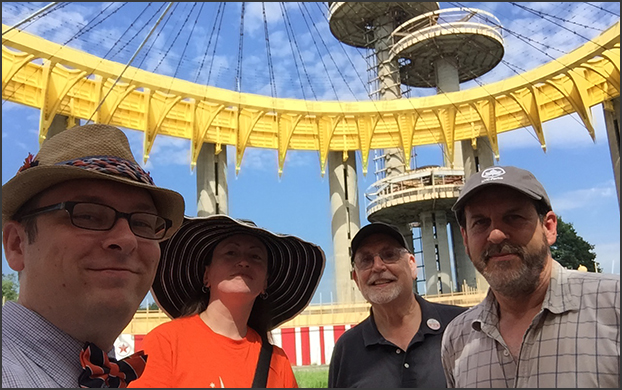
My
next visit would take place in August of 2016, almost a full year
later. As part of that visit, I would have the
honor of meeting representatives of the New York State Pavilion Paint
Project, the team which has been painting and maintaining the
accessible areas of the pavilion since 2009.
Their goal is to
increase awareness of the pavilion and provide it with a little dignity
while it awaits adaptive reuse in the hopefully near future.
As
part of my visit, they gave me a tour of the pavilion and shared loads
of historical information.
They
took me to an area just inside the gates of the Tent of Tomorrow, which
is only accessible to visitors during special "open gate"
events.
There, they showed me a section of the giant terrazzo map of
New
York State. This section, which has been removed from the
floor
and preserved, demonstrated the hard work which went into its creation.
The
floor was left open to the elements for decades following the removal
of the roof. While the floor is largely intact under the
protective coverings, restoration will require a lot of money...and
effort.
The
Paint Project Team continued the tour by showing me where the different
exhibit spaces were located throughout the pavilion. They
even showed me
evidence of some of the other ways the pavilion had been used post-fair.
On
one section of yellow wall, there is what looks like graffiti painted.
While someone else might have been quick to paint over it,
sharp
eyes would recognize it from the 1978 musical The Wiz, which filmed a
segment in the pavilion. That graffiti has been preserved as part
of the pavilion's history.
I
was shown where the pavilion's restaurant was located and was given
a rare chance to snap a couple photos from the far end of the pavilion
before we had to leave.
While
I was walking, I could imagine the
roof and exhibits in their places thanks to the very descriptive
stories I was being told. I was mentally re-living the Fair
through their words...and it was an amazing experience. If
you
are ever in Queens on the day of an "open gate" event, you should
endeavor to make it a scheduled part of your visit. They are
very
popular... so be sure to plan to get there early!
In June
2019, I returned again to participate in the "Only In Queens Summer
Festival" with the New York State Pavilion Paint Project.
The festival, held annually, is a showcase of what makes "The
World's Borough" so amazing.
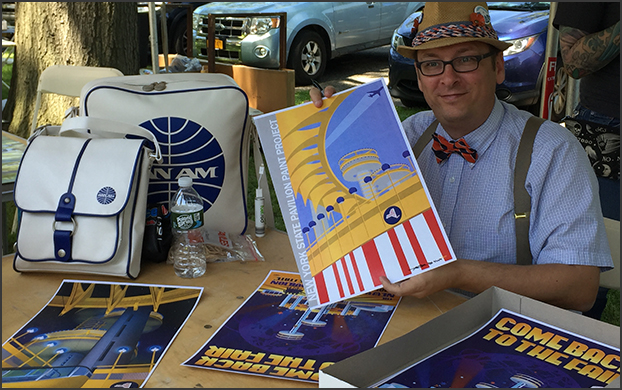
The Paint Project team was on-hand
to promote their group, raise money, and give a virtual tour of the
pavilion during the event. I was there to help them raise
money
by offering signed copies of my original New York State pavilion
artwork to anyone who made a donation to their worthy cause.
I
was so happy to have finally been part of something which would help
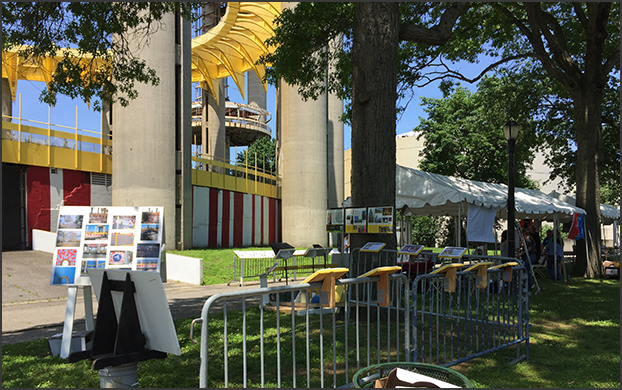
the pavilion. Our area, set up in the grass across from the
North
entrance of the pavilion, had a clear view of the brightly-colored Tent
of
Tomorrow and
the observation towers.
During the event, people walking to and
from the event's main area stopped by to learn more about the pavilion
via the exhibit space and by talking to the on-site members of the
Paint Project team...who each shared their personal World's Fair
stories.
In
the exhibit area, visitors enjoyed a self-guided tour along a timeline
which told the story of the pavilion from design through construction
and beyond to its post-Fair life. Sub-displays told the stories
of Philip Johnson, the architect of the pavilion, and other important
individuals who helped design and construct this unique venue.
You
could tell the team was very passionate about the pavilion and did
their research in order to share every single detail which would
energize those at their exhibit.
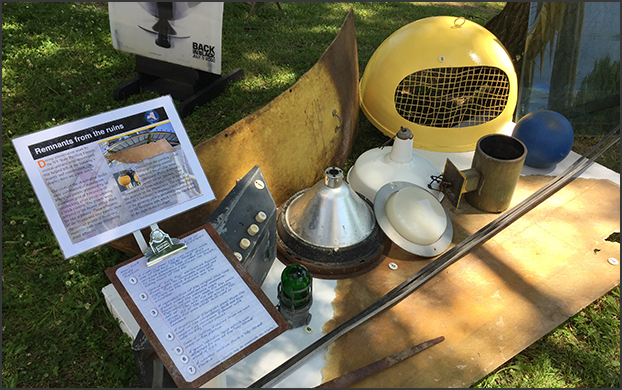
The
last section of the exhibit showcased "relics" which had been recovered
from the pavilion during various cleaning, painting, and maintenance
jobs. Light fixtures, equipment, and even a piece of one of
the
Sky Streak elevators was on display, along with a key to tell the
stories of each part.
The
team hopes that by hosting displays
like this at events in the park, they will help increase awareness of
the pavilion and energize the community to do their part and help bring
it back to life for the enjoyment of all in the near future.
By
the time the event came to an end, I truly felt like part of the team.
My artwork was relatively popular with the locals, with all
copies being snatched up and helping raise a fair (get it?) amount of
money for the New York State Pavilion Paint Project.
Towards the
end of my "day at the Fair", we all joined in and sang the "New York
Transit Authority Subway Special" jingle from the New York World's Fair
1964/1965... and it was awesome! I hope to return again very
soon!
This film
clip shows the New York State pavilion in operation during the Fair.
It is from the NBC-TV film "A World's Fair Diary" (1964)
narrated by Edwin Newman. This video clip is shown here
courtesy of YouTube user Bob Foreman.
The
significance of this relic is most definitely not
lost on the general public who see it everyday on their way to work or
while they walk beautiful Flushing Meadows Corona Park. While
some may not fully understand the history of the pavilion or what it
might have looked like in its glory days, the New York State pavilion
has become as much a symbol of Queens as the Unisphere itself.
With stabilization and restoration work taking place as early as 2020,
it won't be long until we will all be able to take a Sky Streak
elevator to the top tower for that long lost view of the Manhattan
skyline.
If you'd like to be part of this World's Fair remnant's story, I
encourage you to donate to The New York State
Pavilion Paint Project's website.
They are working hard to maintain the mezzanine structure of
the Tent of Tomorrow and provide opportunities to step inside the
pavilion during scheduled "Open Gate" events.
You may also send a note of encouragement to the President of the
Borough of Queens via their website.
Giving Thanks.
The
following individuals contributed towards making it possible for me to
visit and document this remnant of the 1964/1965 New York World's Fair.
I'd like to take a moment to personally thank them for
helping
make my dream of personally visiting the remaining pavilions of the
World's Fair come true.
John DePalma
Nicole Desmond
Joseph Desmond
Reesa Martin
Mitch Silverstein
Stephanie Bohn
Thomas Bleuzen
This page is hereby dedicated to them.
*Postcard Image - Scanned from the personal collection of Jason "Tiki"
Tackett.
**Official Guidebook Information - Official
Guide New York World's Fair 1964/1965 (c.1964 Time Inc.)
TIKITACKETT.INFO/WORLDSFAIR
is an unofficial New York World's Fair 1964/65 fan site and is in no
way affiliated with any single organization or group representing the
Fair's legacy.
Some parts of this website may feature Copyrighted
material which belongs to others. In these cases, appropriate
recognition is given whenever possible. No
parts of this site are to be reproduced without permission.
Peace Through Understanding MADE IN THE U.S.A.